The Egyptian Philosophers by Molefi Kete Asante
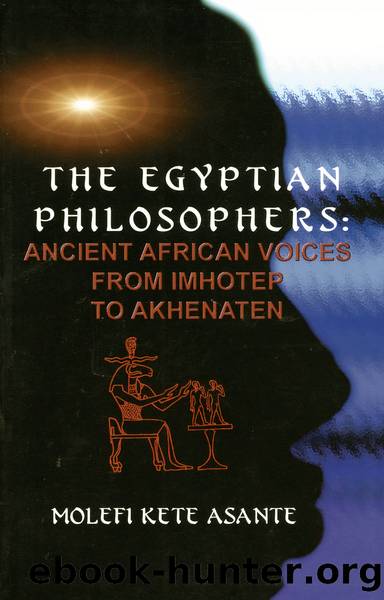
Author:Molefi Kete Asante
Language: eng
Format: epub
Publisher: African American Images
Published: 2000-11-15T00:00:00+00:00
The Six Djeds
Devotion: Kagemniâs teacher says that the priest of the living performs right actions without seeking rewards. This is surely a search for the ideal. The philosopher sees the ideal in the priest of the living, i.e., those priests who are engaged in the mediations, and worldly matters involving the living. The priests who officiate for the dead have other responsibilities. But those who minister to the living must have the character to do right without looking for any type of reward; one should do right because it is right. This is the full meaning of devotion. When we think of a full measure of devotion we immediately think of one who is willing to give his or her life for what they believe is right. One can be devoted to another or to a cause, but the highest reward is to be devoted to a cause that involves human beings. The Christians say that Jesus was devoted to sinners because he was willing to give his life that sinners might be saved. Africans point to the sacrifice of Nat Turner, Denmark Vesey, and Gabriel Prosser in the quest for African liberation from enslavement in America. They knew that if they failed in their devotion to their cause they would be killed and yet they continued with their plans.
Compassion: Notice how the philosopher says that the ideal person has compassion for all living creatures. He is suggesting that the ideal person recognizes something in all living creatures that are special, unique, and inherently wonderful. In this respect, the Kagemni instructions helped to mold the Egyptian way of life and the response to the environment. At such an early age in Egyptian history, a philosopher, one given to living, learning, and teaching at the highest levels of his society, was capable of expressing what evidently was already a major aspect of African philosophy, African pacifism, by the 6th Dynasty. All living creatures were worthy of respect and hence compassion. How could a person just cut down a tree, or catch a fish, or kill a goose, or disturb the river without awe at the beautiful harmony in the universe? The teacher of Kagemni was a significant force in cultivating the more compassionate aspects of Kemetic life. One should understand this type of compassion as sympathy with action.
Different families held to various beliefs about the nature of the earth and its bounty. Some people did not kill rams, others did not kill geese, and still others revered the crocodile. Herein is an indication that totemic responses to the environment might be possible and indeed necessary as a way to control human treatment of other living creatures. If one is respectful of all living creatures, one is at heart applying a system of ecological dignity to the animal kingdom that constitutes the ideal. Early on the Africans discovered that wholesale destruction of the environment and abuse to the ecological balance were dangerous to the human community.
Loyalty: Kagemniâs teacher holds fast the godâs name and teaches others to meditate on it.
Download
This site does not store any files on its server. We only index and link to content provided by other sites. Please contact the content providers to delete copyright contents if any and email us, we'll remove relevant links or contents immediately.
| Anthropology | Archaeology |
| Philosophy | Politics & Government |
| Social Sciences | Sociology |
| Women's Studies |
Cecilia; Or, Memoirs of an Heiress — Volume 1 by Fanny Burney(32558)
The Great Music City by Andrea Baker(32019)
Cecilia; Or, Memoirs of an Heiress — Volume 2 by Fanny Burney(31956)
Cecilia; Or, Memoirs of an Heiress — Volume 3 by Fanny Burney(31942)
We're Going to Need More Wine by Gabrielle Union(19046)
All the Missing Girls by Megan Miranda(16028)
Pimp by Iceberg Slim(14507)
For the Love of Europe by Rick Steves(14121)
Bombshells: Glamour Girls of a Lifetime by Sullivan Steve(14075)
Talking to Strangers by Malcolm Gladwell(13370)
Norse Mythology by Gaiman Neil(13365)
Fifty Shades Freed by E L James(13241)
Mindhunter: Inside the FBI's Elite Serial Crime Unit by John E. Douglas & Mark Olshaker(9343)
Crazy Rich Asians by Kevin Kwan(9292)
The Lost Art of Listening by Michael P. Nichols(7506)
Enlightenment Now: The Case for Reason, Science, Humanism, and Progress by Steven Pinker(7313)
The Four Agreements by Don Miguel Ruiz(6765)
Bad Blood by John Carreyrou(6621)
Weapons of Math Destruction by Cathy O'Neil(6280)
